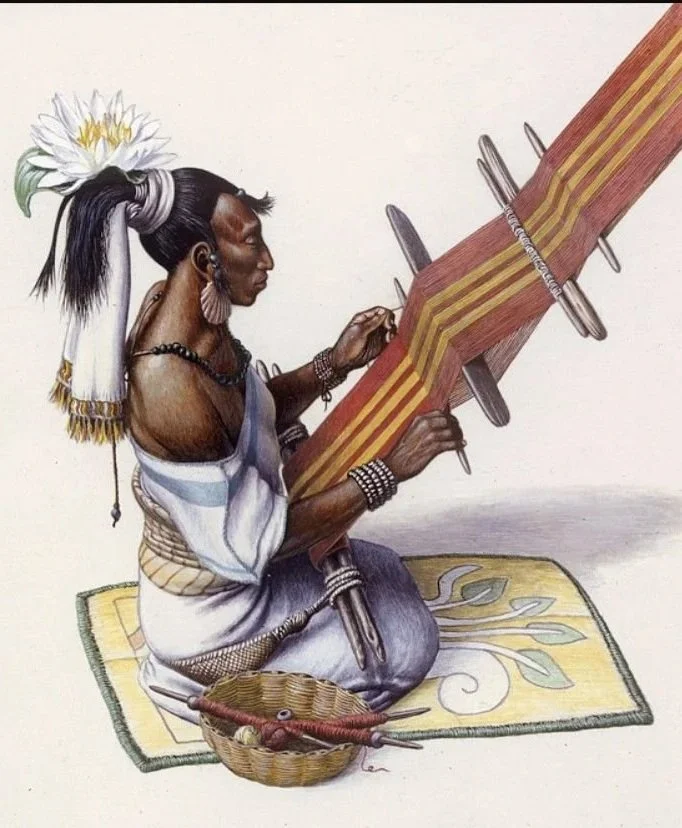
THE BACKSTRAP LOOM HAS BEEN USED FOR OVER 4,500 YEARS. EXTENDING FROM MEXICO ALL THE WAY DOWN TO PERU, IT IS ONE OF THE OLDEST FORMS OF WEAVING, STARTING IN APPROXIMATELY 2400 B.C.
ACCORDING TO ORAL TRADITION, IXCHEL (THE FEMININE ENERGY OF THE MOON IN YUCATEC MAYAN) INVENTED & GAVE THE MAYAN PEOPLE THE KNOWLEDGE OF WEAVING, WHILE HER DAUGHTER, IX CHEBEL YA'AX TAUGHT THEM EMBROIDERY.
TODAY IT STILL RESONATES WITH THE INDIGENOUS PEOPLE OF ANAHUAC ~ TAWANTINSUYU AS THE CLOTHES ARE STILL WORN IN MANY COMMUNITIES IN MEXICO & SOUTH AMERICA.
Mayan Cultural Heritage…
What’s Special About Tzotzil Mayan Textiles…
LEARN MEANING WITHIN MAYAN CLOTHES
The Huipil — Sacred Woven Garment
The huipil is the classic Mayan women's blouse. Each community's huipil is distinct — colors and patterns mark which village a woman comes from, her ceremonial roles, and family lineage.
For the Tzotzil, those intricate patterns aren't just decoration — they are a LIVING CODEX. Every diamond, flower, and animal woven into a huipil (blouse) acts as a visual signature, often telling the story of the weaver’s community, and her relationship to the Maya cosmos.
This is not just a beautiful description of a truly labor-intensive art form. The huipil is incredible because the weaver becomes an intricate part of the garment, where every thread is an act of creation that mirrors the origin of the universe. It is a sacred instrument of cosmological alignment and creation. In Maya philosophy, the act of weaving is a metaphor for the birth of the universe and the continuous renewal of life.
With the Large, upright diamond patterns representing the dimensions of the universe and the unity of earth and sky. The points of the diamond often track the sun's daily motion from east to west & north to south, with the center representing the zenith or the nadir.
more about the huipil
Women's Cooperatives & Fair Trade
Papalotl™ sources exclusively through women's cooperatives not only in San Cristóbal de las Casas, but many of the surrounding highland communities. Every purchase directly supports the economic independence of Tzotzil and Tzeltal Mayan women artisans. Browse the Papalotl store to shop with impact.
Supporting the economic independence of Tzotzil and Tzeltal Mayan women through Papalotl ensures that these ancestral techniques remain a viable livelihood. By sourcing directly from cooperatives, YOU are helping to preserve a cultural heritage where every brocade and thread tells a story of community and resilience
When someone buys a piece from the store, they aren't just acquiring a garment; they are participating in the preservation of Maya cosmology. Every thread in a Larráinzar diamond or a floral stitch from Zinacantán acts as a heartbeat for a tradition that refuses to be commercialized into extinction.
It is a beautiful way to ensure that these "weaving ancestors" continue to have a voice in the modern market, while providing the financial stability necessary for the next generation to keep the telar de cintura moving
Indigenous Fashion & Cultural Identity
By wearing authentic indigenous Mexican clothing it’s more than just a fashion statement, it’s an act of political and cultural affirmation. Unlike mass produced imitations, each Papalotl garment is a one-of-a-kind indigenous textile - woven by native Mexican artisans.
Highlighting these garments, as more than a fashion choice—but as a form of resistance against cultural erasure, choosing a Papalotl piece means rejecting "fast fashion" imitations that often misappropriate Mayan iconography without credit or compensation.
By wearing textiles woven by native artisans, you are:
Honoring Lineage: Validating the centuries of knowledge passed down through generations of Tzotzil and Tzeltal women.
Economic Sovereignty: Ensuring that the value of the labor stays within the community, fostering self-sufficiency.
Decolonizing Style: Centering indigenous aesthetics in a modern world, shifting the narrative from "costume" to a living, evolving identity.
It transforms "shopping" into a community act of CULTURAL RECLAMATION.
Every thread in a Larráinzar brocade or a Zinacantán floral piece serves as a bridge between the ancestral past and a self-determined future. Linking the garments to dance and ceremony honors their original purpose — not just as clothing, but as sacred regalia.
So Reclaim your Indigenous Roots, Fashion & Cultural Identity! Wear Papalotl Every Day!
Backstrap Loom Weaving Tradition
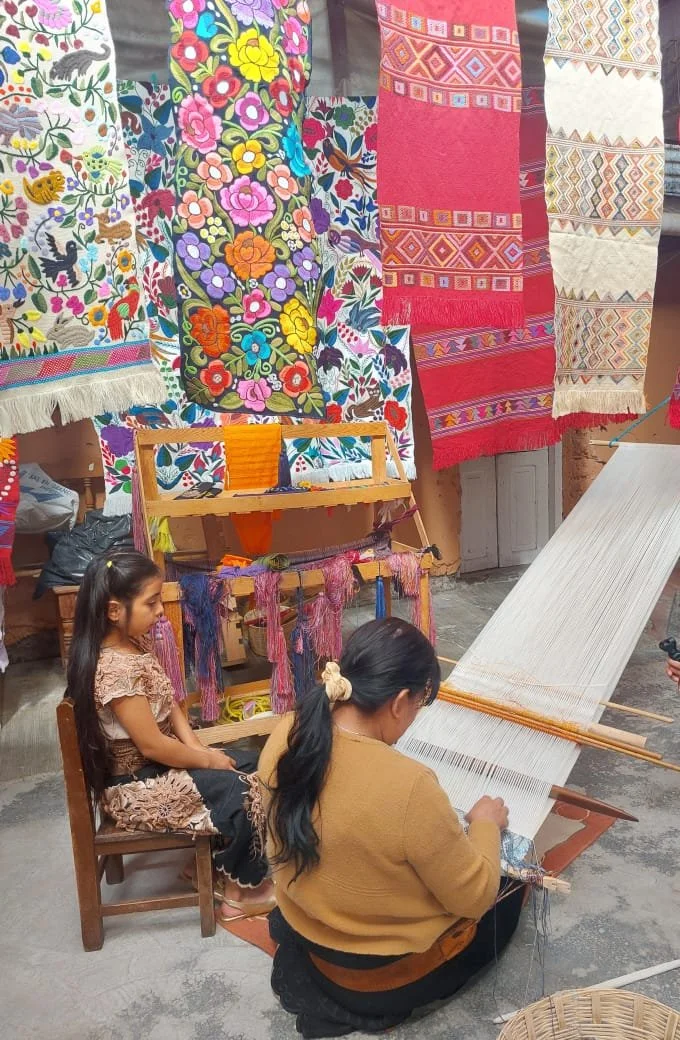
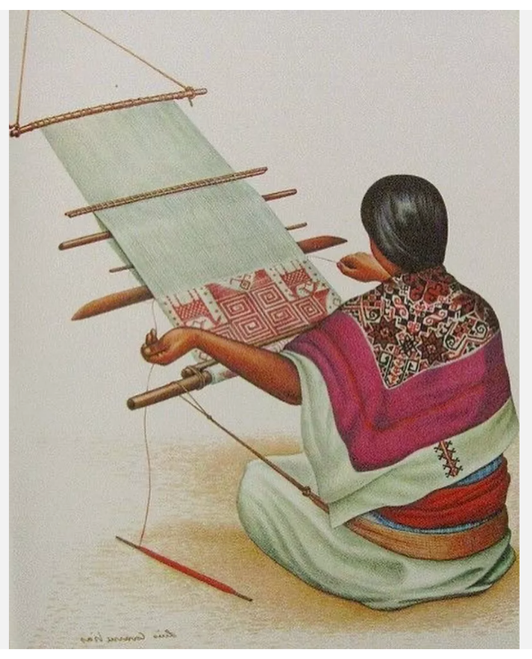
Indigenous women in Chiapas weave on the telar de cintura — a portable loom anchored to the weaver's body. This technique produces the tight, intricate brocade patterns like those found in our Larrainzar Huipiles & Open Sleeve Blouses with a single garment taking weeks to complete at times.
What makes the backstrap loom so remarkable is its physical intimacy between the weaver and the threads. One end is tied to a tree or post, and the other is strapped around the weaver's waist. In a very literal sense, the weaver becomes a part of the machine, using her own body weight to maintain the tension needed to create such dense, symbolic art.
It’s fascinating how each huipil acts as a living language, often carrying ancient Maya symbols that represent philosophy, astronomy, and is theUnity of Body and Earth: the weaver merges with the machine. This physicality makes weaving a radical act of presence and a "kinesthetic memory" that connects the individual to their ancestors.
Are you looking to learn more about the specific meanings of the symbols used in Mayan textiles, or perhaps where to find fair-trade cooperatives that support these artisans? IF SO, LOOK NO FURTHER
shop handmade mayan huipiles
Zinacantán — The Flower Weavers
The Tzotzil community of Zinacantán, Chiapas is famous for its bright floral embroidery on both cotton and acrylic textiles. Zinacantec women's blouses feature chrysanthemum and rose motifs in bold pinks, purples, and greens — a visual feast of living Maya artistry.
Zinacantán, or "Place of the Bats" (Sots'leb), is a striking contrast to the geometric precision of Larráinzar. While Larráinzar weavers use the backstrap loom to create ancient Maya cosmological diamonds, the Tzotzil flower weavers of Zinacantán focus on the abundance of their land.
The Living Garden of Zinacantán
The Technique: Artisans use a hand-guided machine embroidery technique known as RELLENO (fill stitch) to create three-dimensional masterpieces that catch the light.
The Colors: Traditional dress often features a dark blue or purple base (representing the volcanic earth) to make the bold pink and green floral designs pop.
Since Papalotl works with both styles, it offers a beautiful duality: the mathematical precision of the Maya universe from Larráinzar and the floral explosion of the natural world from Zinacantán.
Huey Tlahtokan - La Gran Palabra ChicagoAztlan © — 22 Years of Cultural Heritage
Huey Tlahtokan - La Gran Palabra ChicagoAztlan © was founded in the Pilsen neighborhood of Chicago in 2004. It is a dedicated collective that functions as a bridge between Chicago & Mexihco, actively supporting Native Mexican identity as a daily practice for the diaspora via Indigenous Cultural Diffusion. Through cultural education, they ensure that ancestral heritage remains a living, evolving reality rather than just a faded and forgotten memory.
Working with Indigenous Mexican Teachers we organized Nahuatl language workshops, started the Summer Solstice Aztec Dance Ceremony, hosted Art Expos, Film Festivals, Prehispanic Music Concerts,& Multimedia Cultural Events at the community, elementary, high school, and university level across the Midwest — promoting Native Mexican Culture to The People.
Now by connecting the high-quality craftsmanship of Chiapas artisans to the vibrant cultural landscape of Pilsen, Huey Tlahtokan is making the mission of Papalotl even more impactful and contemporary.
By spreading this work beyond Chicago, we created a space where Prehispanic Knowledge & Pride share in the celebration of the physical artistry of the Tzotzil and Tzeltal Mayan people as well.
THIS ISN’T JUST A BUSINESS, BUT A MOVEMENT FOR AUTONOMY & PRIDE.
LEARN MORE ABOUT HUEY TLAHTOKAN